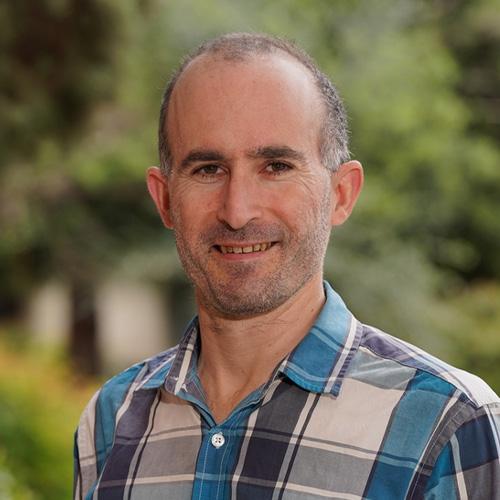
Michael Kunz, Ph.D.
Professor of Biology and Environment Science
AIMS Chair in Science
School of Arts and Sciences
Environmental science is where science meets the social, political and cultural processes impacting the planet.
Whether you’re observing living organisms on field trips or delving into environmental laws, you’ll encounter themes of sustainability and shalom in your coursework, providing you an axis for analysis, reflection and action.
In courses taught by faculty with expertise ranging from ecology to zoology, you’ll gain the scientific training necessary for government, business and non-profit organizations, or graduate study.
As an environmental science major at Fresno Pacific University, you’ll be prepared for a life of environmental service within the global ecological community.
Department Chair: Alan Thompson, Ph.D.
The environmental science program supports the Fresno Pacific Idea goal of promoting "more creative and perceptive relationships between God, humanity and the natural world." The program supports environmentally-focused coursework and service that: (1) educates students in academic disciplines related to the environment; (2) uses the themes of sustainability and shalom (the biblical concept related to peace, wholeness, justice and healthy relationships) to provide a center for analysis, reflection and action; and (3) manifests the principles of the Kingdom of God by preparing students for lives of environmental service within the global human and ecological community.
Environmental science is appropriate for students desiring broad scientific training for government, business and nonprofit organizations, or graduate study in fields related to the environment. The program benefits from Fresno Pacific University's proximity to California's national forests, parks, wildlife refuges and diverse agricultural systems. The program encourages internships with local organizations and student research. Students are also encouraged to supplement their major with summer coursework offered at one of several excellent off-campus programs. Courses taken through these programs may be used as electives or, when appropriate, substituted for required courses.
Main Campus Fresno
Complete additional elective courses to meet the 54 units required in the major (minimum of 12 units from the Division of Natural Sciences)
At Fresno Pacific University, you’ll find an education that empowers you to grow—in faith, knowledge, and purpose. Whether you’re a first-time college student or transferring in, our straightforward application process and personal support make it easy to get started. Discover how to apply and take your next step toward what’s possible at FPU.
FPU guarantees graduation within four years in the traditional undergraduate areas of study.
We commit to providing the courses, advising, instruction and preparation. If you fulfill your responsibilities and are unable to graduate in four years, you will receive the needed courses the following semester at no cost in tuition or fees.
This guarantee is limited to basic graduation requirements of 120 minimum units including general education, upper-level and elective courses sufficient for a single major with no minor.
To qualify for the guarantee students must:
Based on a student’s academic GPA. Academic GPA’s are calculated by FPU on a weighted, 4.0 scaled and based on core academic classes in grades 10-12. Renewable if a minimum GPA is maintained.
| Name | GPA | Amount |
|---|---|---|
| Paragon | Full Tuition | |
| President's | 4.00 GPA and above | $18,000 |
| Dean's | 3.75-3.99 GPA | $15,000 |
| Heritage | 3.50-3.75 GPA | $14,000 |
| Faculty | 3.25-3.49 GPA | $12,000 |
| Founder's | Below a 3.0 GPA | $8,000 |
To be considered for a Transfer Academic Scholarship, you must have 12 or more transferable, post-high school units. GPA’s are based on transferable units and calculated by FPU.
| Name | GPA | Amount |
|---|---|---|
| Transfer Scholar | 3.50 GPA and above | $14,000 |
| Transfer Achievement | 3.0-3.49 GPA | $10,000 |
| Transfer Academic | 2.40-2.99 GPA | $7,500 |
| Transfer Partnership | Below a 2.4 GPA | $6,000 |
| Name | Amount |
|---|---|
| Athletic | $500 to Full Tuition |
| Music | $400 to $10,000 |
| Theatre Arts | $500 to $4,000 |
| Art/Design | $500 to $4,000 |
| Name | Amount |
|---|---|
| FPU Possibilities Scholarship | Full Tuition |
| Church Match | $500 to $1,500 |
| International Scholarship | up to $6,000 |
| Mennonite Brethren Award | $4,000 |
| Out of State Student Scholarship | $4,000 |
| Other Awards | $100 to $10,000 |
| Name | Amount |
|---|---|
| Cal Grant A | $9,358 |
| Cal Grant B | $1,648 |
| Pell Grants | $750 to $7,395 |
| Federal Supplemental Educational Opportunity Grant | $1,000 |
| Name | Amount |
|---|---|
| Federal Direct | $3,500 to $7,500 |
| PLUS Loan | Up to remaining cost |
| Work-study | Contingent on employment |
Alumni, parents, friends, businesses and foundations have generously provided a special set of scholarships available to students attending Fresno Pacific.

Alexandra Green
The grants, the academic awards, the transfer scholarship – all of it makes it so much more affordable to attend FPU. I know that school isn’t cheap for anyone, but FPU helped me realize that I could actually come to this school because they were going to help me so much financially.
Now that you’ve seen the financial aid opportunities available to FPU students, we can estimate what your true cost may be to attend Fresno Pacific. Please keep in mind that this is just a computer generated, general estimate and may not capture all aid available, please work with your FPU Student Financial Services advisor to discover your true net price.
Environmental scientists are prepared for a range of career paths, including teaching, research and governmental work. This program will also equip you for graduate study, including teacher credential programs. Specific opportunities can be found in public affairs, environmental consulting, conservation and preservation.
The staff in our Career Development and Experiential Learning Center are here to help you prepare to enter the working world. Whether you're a freshman or an FPU alum, there are a number of resources and trainings offered to help you find the internship and job you’re looking for.