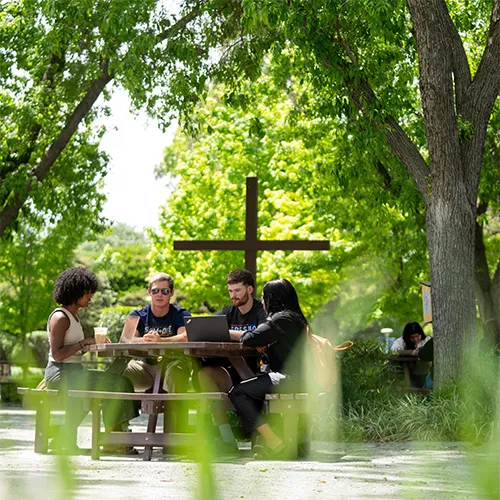
These principles are woven into our social work programs and rooted in Jesus’ words in Matthew 22:36-40. When asked which commandment was the greatest, Jesus responded:
“Love the Lord your God with all your heart and with all your soul and with all your mind.”
He then added a second commandment:
“Love your neighbor as yourself.”
Those words offer a meaningful framework for thinking about the work social workers are called to do and the kind of people we hope our students become.
As a program centered on Christian principles, we encourage students to thoughtfully consider how faith, spirituality and religious thought intersect with the practice of social work.
Students in our programs are not required to come from a Christian faith tradition. They are, however, asked to engage in thoughtful reflection about ethical faith integration and practice. This includes examining empirical literature, developing professional skills and learning how to work respectfully with the faith, spirituality, beliefs and values of the people they serve.
Social workers encounter people from a wide variety of backgrounds and belief systems. Understanding the role that faith and spirituality can play in people's lives helps prepare our students to approach those conversations with humility, respect and professional competence.
For Christian students, this also creates opportunities to consider what it means to love God through their vocation. How might faith influence the way we listen? How we serve? How we respond to injustice? How we recognize the inherent worth of another person?
These are important questions, and we want our students to have a place to wrestle with them.
Social work is, at its heart, a profession centered on people.
Jesus' command to “love your neighbor” has a particularly meaningful connection to a profession committed to human well-being and to helping people who are vulnerable, oppressed or living in poverty.
The National Association of Social Workers' Code of Ethics describes the profession's primary mission as enhancing human well-being and helping meet the basic needs of all people, with particular attention to people who are vulnerable and marginalized.
For social workers, loving our neighbors is more than an abstract idea. It takes shape in the everyday work of listening, advocating, supporting and serving.
Our neighbors may be children and families navigating difficult circumstances. They may be people experiencing poverty, trauma or homelessness. They may be individuals working through mental health challenges or communities facing systemic barriers.
Social workers have the privilege and responsibility of entering into these spaces and asking: How can I serve this person well? How can I help? How can I advocate for dignity, opportunity and well-being?
At FPU, we want students to graduate prepared to ask those questions and equipped with the professional skills to act on the answers.
There is another important part of Jesus' command that can sometimes be overlooked: “Love your neighbor as yourself.”
Social work can be deeply rewarding, but it can also be demanding. Social workers regularly encounter complex situations, significant needs and the pain and challenges experienced by the people and communities they serve.
That makes healthy boundaries and self-care essential parts of professional practice.
Our programs are rigorous, and there may be times when students feel stretched and challenged. Part of their education is learning that caring for themselves is not separate from becoming an effective social worker. It is part of becoming one.
The NASW Code of Ethics recognizes this as well, encouraging social workers to take measures to care for themselves professionally and personally.
Learning to establish healthy boundaries, recognize personal limitations, seek support and care for one's own well-being helps prepare social workers for sustainable service. We cannot separate caring for others from learning how to responsibly care for ourselves.
Love God. Love others. Love self.
These ideas are deeply connected. They remind us that social work is about more than learning theories, completing assignments or developing professional competencies. It is about preparing people to enter communities with knowledge, compassion, humility and integrity.
At Fresno Pacific University, our goal is to prepare social workers who are ready to serve diverse individuals, families and communities and who understand the responsibility that comes with being invited into people's lives.
For our students, that journey begins in the classroom, continues through field experience and ultimately extends into the communities they will serve.
My hope is that throughout that journey, they continue returning to these three principles: love God, love others and love self.