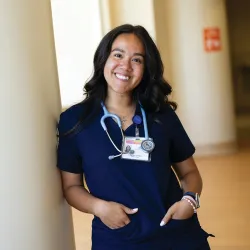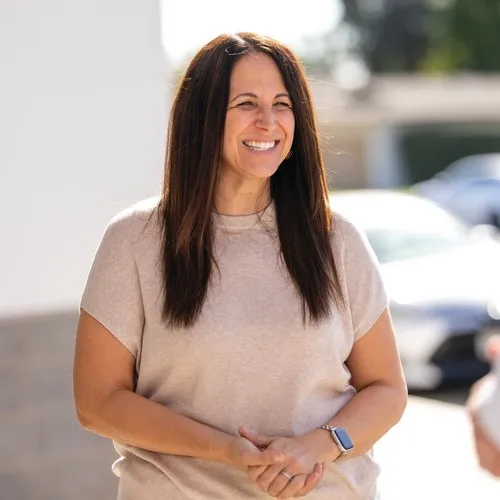
Angel Krause, Ed.D., wants to give young people opportunities—including those they don’t know they have.
That was Krause’s situation when she stopped by her guidance counselor’s office as a senior at East Union High School in Manteca. Knowing her near-4.0 grade point average, the counselor asked her what colleges or universities she would be applying to.
Thus dawned Krause’s first thought of higher education. “I’m a first-generation student, so there was no discussion of college in my family,” she says.
That family was headed by a single mom and included half-siblings. Their first house was all of 600 square feet.
Caught off guard, Krause leaned into the faith that was already part of her life. “My question to the counselor was, ‘What’s the closest Christian college?’”
That was Fresno Pacific University, and thus a college search was begun and ended. “I didn’t apply anywhere else,” Krause says.
Foundation for Achievement
Fortunately, Krause had already been laying a foundation for achievement that would pave her way to FPU and beyond. She got a President’s Scholarship, then FPU’s highest academic award, and a track scholarship as well as state and federal aid. She also served as a mentor assistant her sophomore year and a residence assistant her junior year.
Krause’s original plan to teach math was more about convenience than passion. “I could always do it, but didn’t really love it,” she says.
Then came history classes with a murderers’ row of heavy hitters: Paul Toews, Ph.D.; Steve Varvis, Ph.D.; Richard Unruh, Ph.D.; and Rich Rawls, Ph.D. As extra credit, Brad Krause (MA ’07, TC ’01, BA ’00), a fellow history major and thrower on the track team, caught her eye. They married between their junior and senior years. He is now junior high principal at Immanuel Schools in Reedley after serving as a teacher and administrator at Madera South High School. The couple has three daughters.
“I can still hear Rawls’ laugh and see Unruh’s stare,” Krause remembers with a laugh. She also served as a student assistant to Toews. These master teachers were as approachable as they were impressive. “If they were sitting at a lunch table, they would have students sit with them. It wouldn’t just be a faculty table,” she says.
“That would have been lost at another college where class was just a lecture hall and nobody knew my name,” Krause adds. FPU professors matched high standards with high expectations while supporting and believing in students. “Their availability allowed me to achieve.”
The Multiplier Effect
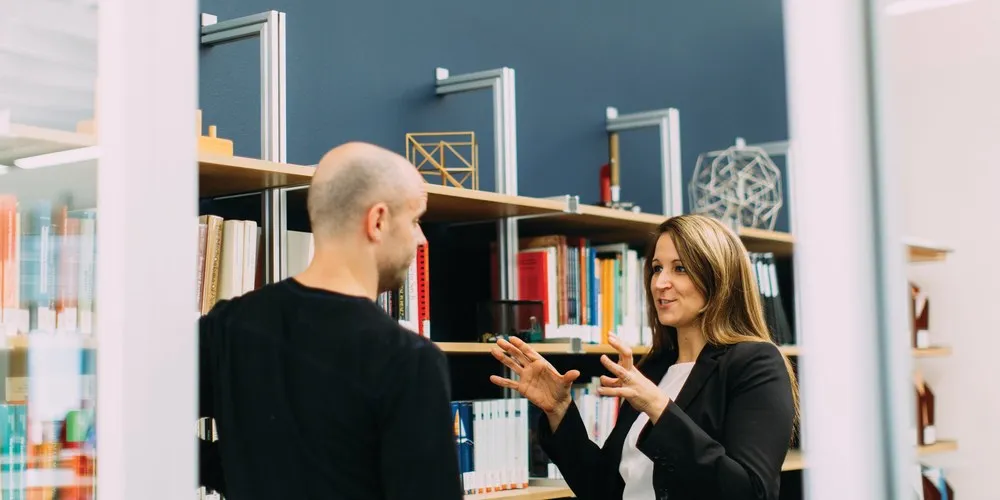
“The most relatable faculty were those who let me engage in the process of learning,” Krause says, and that is the idea she took into her classroom, first at Central West High School in the Central Unified School District, then at a fully online high school of about 2,000 students.
At Central, Krause brought what she learned at FPU lunch tables and classrooms to her teaching. She managed her students through relationships and ate lunch at her desk, where students were welcome to join her. “Being relatable was critical,” she says.
FPU came calling, first in 2007 for an adjunct position, then with a full-time offer in 2010. “I thought I was going to be in the classroom a long time,” Krause says. But veteran education faculty Roberta (Bobbi) Jentes Mason, Ph.D., had other ideas.
Mason asked Krause what she would miss about teaching in schools. “Having an impact on students,” was Krause’s answer, likely the one Mason expected. The professor had a ready response, probably with her trademark twinkle in her eye: “You know all the students you have at FPU will be impacting students in their own classrooms,” Krause remembers.
The multiplier effect would eventually echo to reach thousands. “It just goes on and on,” Krause adds.
Empathetic Throughline
Today, Krause is associate professor of education and program coordinator in the Office of Clinical Practice. Her B.A. in Social Sciences, teaching credential, and M.A. in Education are all from FPU, and her Ed.D. is from George Fox University. “You look back on it, and you see it’s God’s plan. But in the midst, you’re like, ‘What’s going on?’”
Empathy—believing in and supporting her students toward success—is the throughline of Krause’s work. “I remember what it was like,” she says. “I always shared my story with my students. We had more in common than they realized.”
Education blending standards, expectations, and support breaks cycles. For Krause, that cycle was poverty. For others, it could be something else. “It becomes social justice work, and it’s embedded in The Fresno Pacific Idea,” she says.
“In the midst of test scores and behaviors, you are teaching beyond the curriculum and your walls,” Krause says. “My students should know it’s possible and we’re in this together.”
Have an idea for Sunny's Blog?
Email storyteam@fresno.edu.