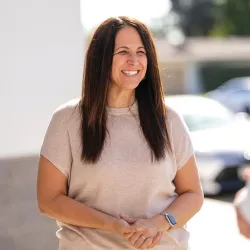
I like to talk about students coming here not just for a degree, but for an education.
Provost Alison R. Noble, Ph.D.
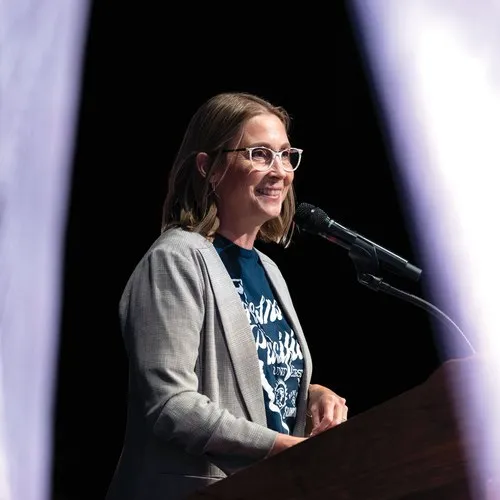
The topics discussed centered on how faith and learning shape the educational experience at Fresno Pacific, as well as the goals and benefits of receiving an education.
Noble: As people of faith, we have a framework for how we do our work, how we think about life, what we value, and the ways that we navigate the world. As students or scholars, we are also committed to becoming experts in our chosen fields. “Faith and Learning” is about becoming conscious of and intentional about the ways that our faith and our learning are informing each other—how they are in dialogue. Faith and learning, at its best, is a conversation between our faith and our disciplines and how each one shapes and enriches the other.
Noble: Well, it depends on how far back you go. In the last 100 years? Yes, faith and learning have really been siloed; there certainly has been a lot done to make it seem like faith and science, for example, are two separate things. But if you look across time and culture, faith and learning have been in dialogue for centuries. Humans will always be asking questions, implicitly or explicitly, that are best answered through a dialogue of faith and learning. What is it to be human? What’s my meaning? Where did life originate? What’s my purpose? Why am I here? These questions have been a focus of both science and the humanities for centuries (if not longer), particularly in the sister disciplines of philosophy and theology. The dialogue between faith and learning is critical to answering these fundamental questions well.
Noble: We want our students to leave here with knowledge and skills. We also want our students to leave here with wisdom, discernment, a commitment to the common good, and an understanding of how their faith is in conversation with their discipline.
A nurse might have a really robust conversation about what it is about nursing that aligns with their Christian calling. A biologist would have a similar conversation, with different pieces that resonate. A nurse might say, “I really feel like my Christian calling is to serve the poor or to serve people who are suffering and to relieve the suffering that I see in the world.” A biologist might say, “I’m curious about the natural world, and, by studying it, I can learn more about God, more about creation, and discern how the discoveries and mechanisms of biology can serve the needs of the world.” These are fundamental questions, and they look different in different disciplines. But the questions themselves have a great deal in common.
Noble: It certainly isn’t uncommon for a faculty member at Fresno Pacific to pray at some point during class, but that is not what we mean by faith and learning. Faith and learning is about opening a dialogue between faith and your discipline, whether it’s an applied or discovery discipline.
How do faith and your discipline inform each other? What questions do they ask of each other? In what ways does that friendship have tension? What do I do when what I thought about my discipline and what I thought about my faith seem to not match perfectly? We would love for our students to have a maturity where they can ask that question and sit in the tension of that question long enough to explore answers, rather than feeling like they have to immediately jettison their faith or jettison what they’re learning. They can say, “This is a conversation. There is a lot more to learn, and I can trust God to be present and faithful in that conversation. I don’t need to be afraid.”
Noble: It really depends on the classroom. It depends on the faculty member. Our faculty are authentic in the way that they introduce this with their students. It’s not formulaic. It requires that the faculty member has done this work themselves before they try to do it with their students.
In a psychology or criminology classroom, they might be looking at a case study, and a faculty member might ask students to consider their personal faith commitments and how those commitments inform not just what they do, but how they interact with the people they will be serving in their professional roles. In the science classroom, it might include exploring the ways that Christians over the centuries have understood the relationship between natural law and hermeneutics or theology. The Nobel-prize winning physicists Niels Bohr and Albert Einstein, for example, held a well-known conversation over many years about the implications of quantum mechanics for their understanding of theology, determinism, and how God created and engages the natural world.
In our teacher preparation department, their area-specific mission is to encourage candidates to view teaching as a calling to redemptive service and preparation as scholars, professionals, peacemakers, and leaders. School districts around Fresno Pacific hire our teachers because they are excellent classroom teachers. The faith-informed values undergird the work that our teachers do every day and why they do what they do. They are excellent teachers not only because of their skills, but also because they have explored the fundamental calling of what it is to be a teacher.
Noble: Students will be able to ask fuller human questions at a Christian university. The opportunity to ask important questions of meaning and purpose exists here in a way that is harder to find elsewhere. While it is not impossible to ask these questions at state universities, it’s harder to find and less intentionally incorporated. There’s really, in some ways, more room to ask the big questions at a place like Fresno Pacific.
I want to be clear that I’m not saying that secular institutions are bad and Christian institutions are good. It’s not binary like that; there are all kinds of tradeoffs for most decisions, including where to go to school. But I do think secular institutions are a bit hobbled because students complete coursework in a context where faith is often extracted from fundamental questions. A really important part of the character of a Christian university is its community of learners who walk together in intentional conversation about the ways that faith and discipline inform one another.
Noble: I like to talk about students coming here not just for a degree, but for an education. When someone has a degree, they check two boxes: They have demonstrated sufficient skills and have enough knowledge to complete the coursework required to earn a degree. That’s great. We want them to have that. That’s not in opposition to being an educated person—in fact, it is necessary. But it is not sufficient. An educated person is fundamentally curious. They listen well. They know why they think what they think, but they also want to understand why other people think what they think. Coming to college is fundamentally an opportunity to emerge as a more thoughtful, curious, and engaged (i.e., educated) person—the degree comes along for the ride.
Noble: Yes, we want students to learn information and also to think well. Educated people are secure enough to be curious about themselves, others, and the world. They have trained in the ability to sit with uncertainty long enough to learn new things.
This principle is evident when we think about the way that Jesus taught in parables. When asked a question, Jesus didn’t typically reply with, “Let me give you the three simple steps you need.” Jesus told stories. Jesus invited people into the conversation. This approach calls people to engage, to think, and to be curious, to have understanding for different perspectives. Stories are ways of showing that reality is complex and inviting people to explore that reality fully. Jesus was a master teacher.
Noble: Just whatever comes to mind?
Noble: Both. In the morning, I will drink an English breakfast tea with a dash of real maple syrup and a little bit of half-and-half. In the evening, I drink rooibos tea, which is a red tea, with nothing added to it. I also like coffee, but typically a light roast or a medium roast French press. I also drink that with a splash of maple syrup and a little bit of half-and-half.
Noble: You know, it used to be tea more often than coffee, but I’d say it’s pretty split now.
Noble: Evening.
Noble: Nope. Evening all the way. I wish I was more of a morning person, but I’m a night owl.
Noble: Text.
Noble: Okay, here’s the thing. I’m going to say mountains, because when people say beach, they think of a Southern California beach. I would much prefer the Oregon coast, where it’s cold and you have to wear a fleece while you walk the beach.
Noble: Yes! A fleece and some light drizzle on the Oregon coast would be my actual answer, but if I say “beach” then people imagine a lounge chair in the sun.
Noble: Yes, beach with context.
Noble: Podcasts.
Noble: Okay, if you really want to know my favorite color, it’s CoAl₂O₄.
Noble: It’s a bright blue, also known as “cobalt blue.”
Noble: That is really hard! I like so many foods, it’s hard to pick one.
Noble: Oh, that’s easy then. Coffee ice cream.
Noble: Again, that’s so hard to pick just one.
Noble: Matthew 28:20 because it talks about how Jesus is with us always, even to the end of the age. We’re not promised that life won’t be hard, in fact quite the opposite, but we are promised His constant presence. That is an abiding comfort.
Noble: It’s such a beautiful campus. Really, I just like to be wherever people need me to be.
Noble: Alive.
Email storyteam@fresno.edu.