Every term, we meet adults who were a semester or two from finishing when life got in the way. A job needed more hours, or a family needed them home, and the plan to go back kept sliding to next year. Maybe that sounds familiar. The degree still sits there unfinished, and so does the quiet question that comes with it: Is it too late?
You’re in good company. The National Student Clearinghouse Research Center counts 37.6 million working-age Americans with some college but no credential, about 6 million of them here in California. Degree completion programs were built for people in exactly that spot, and they look very different from the college schedule you might remember.
At Fresno Pacific University, our degree completion programs are for adults ready to finish what they started. We believe the years you spent working and raising a family away from school count for something, and we see your return as part of a larger calling.
A degree completion program is a bachelor’s program designed for adults who already have college credit. Instead of starting over, you transfer in what you’ve earned and complete the remaining courses, usually in a format that fits around a job. Adult degree completion tends to serve a few kinds of students:
- Adults who stepped away: You started a bachelor’s, left for work or family reasons and still have credits on a transcript somewhere.
- Associate degree holders: You finished an associate or transfer degree at a community college and never made the jump to a four-year school.
- Career changers: You want a bachelor’s that opens a different field from the one you work in now.
- Returning FPU students: You took classes at Fresno Pacific and want to come back and finish.
Going back to school as an adult usually starts with one question: What still counts? The answer comes from a transcript review, where we look at every college you’ve attended and match your coursework to what your bachelor’s requires. A few things can shorten the road:
- Credits from an accredited college: Courses you passed with a C- or better can usually transfer, up to 90 semester units, including up to 70 from community colleges.
- An associate degree for transfer (AA-T or AS-T): It covers your lower-division general education except two biblical studies courses you’ll take with us, and the ADT guarantee allows you to complete your bachelor’s in 68 units. With an ADT, you can be admitted with a 2.0 GPA.
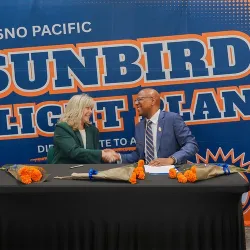
- Classes at a local community college: If you’ve studied at Fresno City, Clovis, Reedley or Madera College, the Sunbird Flight Plan guarantees admission once you have 24 transferable units and a 2.4 GPA. We also partner directly with Reedley College and Coalinga College-Firebaugh Center.
- AP, CLEP, IB, military or ACE credit: Up to 30 units combined can count, with military and ACE credit applied to electives.
Your credits become official once our Registrar’s Office evaluates them, and that’s when you’ll see real numbers. Even if your last class was years ago, those credits may still count, and most questions about old college credits have encouraging answers. To get started, request official transcripts from every college you’ve attended, plus any military transcripts.
A bachelor’s degree for working adults has to fit into a life that’s already full. Four parts of the format make that possible:
You’ll move through your program with the same group of 12 to 22 classmates from start to finish. They’re working and raising families too, and they bring real problems from their jobs into class, so the conversations sound a lot like the ones you already have at work.
Most courses run eight weeks, and you’ll often take two at a time, so you’re focused on fewer subjects at once. Short sessions also mean you see progress quickly, which helps on the nights your motivation runs low. And because general education and elective courses start six times a year, you don’t have to wait long to begin.
Depending on your major, you can take classes in the evening, online or during the day. General education courses run online and at our North Fresno and Visalia campuses, while each major sets its own format. Before you apply, check where and how your program meets.
Life doesn’t pause for school, and we don’t expect it to. The Academic Success Center offers tutoring and coaching, and your advisor helps you plan around what’s ahead. Over time, your cohort becomes a small community that notices when you need encouragement; the kind of people who text you before a big exam or share their notes when your kid gets sick.
Choosing a major is part practical decision and part discernment. It helps to ask what your past credits already cover, what doors you need opened at work and where you feel called to serve. Most degree completion programs center on fields where working adults build careers. Here’s how that looks at Fresno Pacific:
- Business and leadership: Business Administration with emphases in Business Management, Healthcare Administration, Organizational Leadership and Project Management
- Justice and helping professions: Criminology, Psychology, Social Welfare and Social Work
- Education: Early Childhood Development and Liberal Arts (with Education, Science and Special Education concentrations)
- Ministry: Christian Ministry and Leadership
If you’re torn between majors, start with what you’ve already taken: a major that builds on your past coursework usually means fewer units to go. Your current work matters too. If you already supervise people, for example, the Business Management emphasis may build on what you do every day, and its program director explains how the format fits around full-time jobs in a business degree designed with working adults in mind.
Cost comes down to how many units you still need and what aid you qualify for, since most degree completion programs charge tuition by the unit. For 2026–27, tuition for our programs is $567 per unit, plus a $158 student services fee each semester. Those are published estimates and can change, but they give you a real number to plan around. Planning early is also a practical way to honor the commitments you’ve already made to your family.
A few steps can make it more manageable:
- Complete the FAFSA as early as Oct. 1 using FPU’s school code, 001253.
- Contact Student Financial Services at 559-453-2041 to review the types of aid you may qualify for.
- Ask your employer whether it offers tuition assistance for job-related degrees.
- Review the degree completion cost and financial aid details before you apply.
It isn’t, and you won’t be the only one in your cohort making this decision. Going back to college at 30 or 40 can feel like walking into a room where everyone else already knows the rules, but your classmates will be at your stage of life, weighing the same questions you are. You also bring something many younger students don’t have yet: years of work experience you can apply in class the very next day. For a lot of our students, a sense of calling grows clearer once they’re back in a classroom with people who share it.
Many of the students we teach are finishing for someone else as much as for themselves, a child watching them study at the kitchen table or a Valley community they want to serve better. Other FPU students have finished their degrees amid life’s challenges, and the cohort is there so you don’t have to do it alone.
Finishing your degree rarely happens all at once. It usually starts with something small like requesting an old transcript or asking how many units you still need, and then the next step becomes clearer. If you’ve taken classes at Fresno Pacific before, our degree completion team can walk you through coming back, and new cohorts begin Jan. 11 and March 15, 2027.
As faculty, we see finishing your degree as part of a longer story. Fresno Pacific University exists to develop students for leadership and service through excellence in Christian higher education, and we watch that mission come alive every time a student brings their faith and hard-won experience back into the classroom. That commitment, laid out in The Fresno Pacific Idea, is why we teach every course with your whole life in view, including the work and family you bring with you.
It depends mostly on how many transferable units you bring and how many courses you take each term. Some cohort programs, including several at Fresno Pacific, are designed to run about 18 months once you’ve met the lower-division requirements. A transcript review is the quickest way to get a realistic timeline for your own situation, so request one before you compare programs.
Yes. Many degree completion programs offer online courses, and some can be finished without coming to campus. Whether a program is open to you depends on your state, since schools need authorization to enroll online students in each state. Check each program’s delivery options, and ask whether online classes meet live at set times or let you work on your own schedule.
Usually not. Many degree completion programs accept transfer credit whether or not you have completed an associate degree. At Fresno Pacific, you can be admitted and take general education courses first, then start your major once you have 60 transferable units and a 2.4 GPA. Students with 54 to 59 units may petition the program director to begin sooner.
In most cases, yes. Many colleges offer former students a simpler path back than new applicants. At Fresno Pacific, degree completion students who have been away less than five years return through a program re-entry form, while those away longer go through full admission. Either way, you’ll come back under the current catalog and tuition rate.
Yes. You file the FAFSA just like any other student and may qualify for federal grants, loans and state aid, depending on income and enrollment. Federal loans usually require at least half-time enrollment each term. Because aid is tied to the units you take, your enrollment plan shapes your aid package, so map out your schedule with a financial aid counselor before you register.