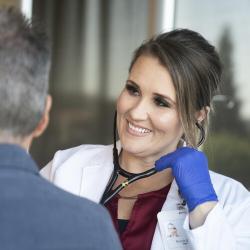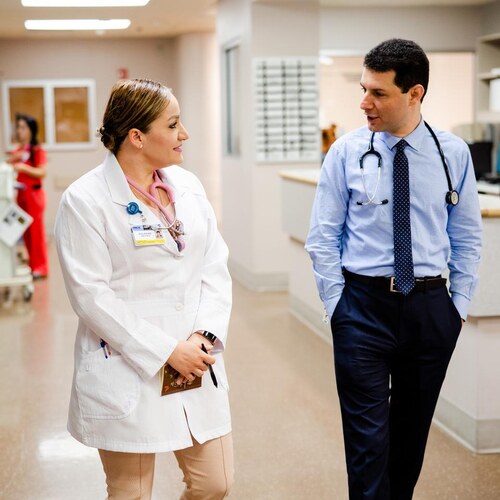

A nurse practitioner and a physician associate/assistant often do nearly identical work at the bedside, yet the two roles are built on very different kinds of training.
Understanding that difference can help you choose the path that actually matches how you want to practice.
A nurse practitioner and a physician associate/assistant are both advanced clinicians trained to diagnose conditions, order tests and prescribe treatment, and if you’re comparing the two, you’ve probably noticed how similar their daily work can look from the outside.
Where the paths actually split is in the training model behind each one, not in what you’ll do once you’re seeing patients. Understanding how each path trains, where their scope of practice differs, and what each specialty track looks like can help you decide which model fits the clinician you want to become, especially if you’re still weighing which route makes more sense for where you’re starting from.
Here at Fresno Pacific University, we train nurses for the nurse practitioner path through the Master of Science in Nursing - Family Nurse Practitioner (MSN-FNP), a program that prepares you to serve the Central Valley through skilled, independent care rooted in a Christian calling. We have also begun developing a physician associate program to support students who are interested in pursuing this pathway.
What Is the Difference Between a Nurse Practitioner and a Physician Associate/Assistant?
If you’re weighing these two roles, you’ve probably noticed that job postings for each one can look nearly interchangeable, listing similar duties and comparable pay. In fact, many healthcare employers use an umbrella term of “Advanced Practice Provider” to describe nurse practitioners and physician associates/assistants because what they do is so similar.
The real distinction between the two professions comes down to your starting point, and in many states that starting point also shapes how independently you’ll be able to practice once you’re licensed.
Here’s how the two roles break down:
- Nurse practitioner: An advanced practice registered nurse who first builds a nursing foundation, then moves into advanced, independent patient care.
- Physician associate/assistant: A clinician trained in the medical model, much like a physician, through a focused graduate program built around broad clinical skills across multiple specialties.
Whichever role you’re drawn to, you’ll likely end up working alongside the other at some point. Nurse practitioners and physician associates/assistants often share the same care team, and neither role outranks the other.
How Do You Prepare to Become a Nurse Practitioner or Physician Associate/Assistant?
Education is the clearest line between the two roles. Each path leads to graduate study, but where you start looks completely different depending on which one you choose. Here’s what training looks like on each side:
The Nurse Practitioner Path
You’ll spend your early career practicing as a registered nurse, then add graduate-level training once you’re ready to specialize. Most nurse practitioners follow a version of this sequence:
- Earn a Bachelor of Science in Nursing.
- Pass the National Council Licensure Examination for Registered Nurses (NCLEX-RN) to become a licensed registered nurse.
- Complete a graduate nursing program, such as a Master of Science in Nursing (MSN), with a population focus like family care.
The Physician Associate/Assistant Path
This route trains you in the medical model from the start rather than through a nursing foundation, and it typically unfolds like this:
- Earn a bachelor’s degree in any field with prerequisite coursework, such as anatomy, physiology, biology, or chemistry.
- Gain hands-on healthcare experience, often as a requirement for PA program admission.
- Complete a PA master’s program built on the medical model.
- Pass the Physician Associate/Assistant National Certifying Examination (PANCE) to obtain a license and practice medicine as a PA.
As a nursing faculty member, I tell prospective students that this training model matters more than most people expect based on their desired focus. Nursing programs center on the whole person, prevention and patient-centered care, while medical programs often center on diagnosing and treating disease from a broad, generalist base.
While these are differences in emphasis, they are not rigid divisions. Both programs provide the type of training that the other provides. Nurse practitioner training includes disease mechanisms and diagnostic reasoning, and physician associate/assistant education also teaches patient-centered communication, prevention and whole-person care. It’s why they can often do similar things in practice. The real difference is the starting point.
What Can a Nurse Practitioner and a Physician Associate/Assistant Do in Practice?
Day to day, the two roles look a lot alike, and their scope of practice overlaps in most clinical settings you’d walk into, whether that’s a family practice, a hospital floor, or an outpatient clinic. As faculty, we tell students not to choose between these paths based on the daily task list alone, since much of that list is identical, but the education and oversight model underneath it is not.
Both a nurse practitioner and a physician associate/assistant can:
- Examine patients and review health histories.
- Diagnose illnesses and injuries.
- Order and interpret lab work and imaging.
- Prescribe medications.
- Build and adjust treatment plans.
Where the roles differ is in how much oversight you’ll need. In many states, a nurse practitioner can practice independently, while a physician associate/assistant usually works with a supervising or collaborating physician, though more states are changing their laws to allow more flexibility in how PAs practice with higher levels of autonomy and independence. Both can prescribe medications within the limits your state sets, regardless of which path you choose. Both can work in surgical subspecialties.
How Do Nurse Practitioner and Physician Associate/Assistant Specialties and Salaries Compare?
Specialty choice is another place these paths split, and it’s worth thinking through now rather than after you’ve already committed to a program.
As a nurse practitioner, you’ll choose a population focus during graduate study, such as family, pediatric, psychiatric mental health, adult-gerontology, or women’s health, and that focus becomes the lane in which you build your expertise over time. As a physician associate/assistant, you’ll train as a generalist instead, which means you can move between specialties over time without earning a new certification each time your interests shift.
Pay for both roles sits well above the typical registered nurse’s salary, though the numbers aren’t identical. The U.S. Bureau of Labor Statistics groups nurse practitioners with nurse anesthetists and nurse midwives in its wage data, and that combined category reported a median annual salary of $134,920 as of May 2025, with employment projected to grow 36% by 2035. Physician associates/assistants reported a median annual salary of $135,880 as of May 2025, with employment projected to grow 21% by 2035.
Wherever you land, that demand reflects something bigger than a job market trend. Communities across the country, including right here in the Central Valley, need more providers willing to serve close to home, and for many nurses and PAs, that need is part of what makes the work feel less like a career and more like a calling.
How Do You Choose Between Becoming a Nurse Practitioner or a Physician Associate/Assistant?
The better fit depends on your background and the kind of care you want to give. You’ll likely find the decision gets easier once you stop comparing job titles and start asking where you’re starting from and what kind of clinician you want to become.
- Start from your foundation: If you’re already a working RN, the nurse practitioner route can be a natural next step, and an RN to BSN pathway can fill the gap if you haven’t finished a bachelor’s yet. If you’re drawn to broad medical training instead, the PA path may suit you better.
- Consider your preferred model: Decide whether population-focused care or generalist medical training fits how you want to practice.
- Check your state: Review your state’s practice rules before you decide, since scope and independence vary widely for both professions by state.
Students often ask which path is harder. Neither is objectively harder than the other, though the nurse practitioner path takes longer overall because it includes time working as an RN first while the PA route condenses broad medical training into a more intense stretch of school.
As faculty, we encourage you to weigh one more factor alongside these: which path aligns best with your calling. For me, that’s part of why so many working nurses gravitate toward the NP route since it builds on the kind of Christian, faith-rooted care they’ve likely carried since they first became a nurse. Our developing PA program will provide the same faith focus, but with different requirements for preparation that do not require a nursing background.
How Does Fresno Pacific University Prepare You to Become a Nurse Practitioner?
Here at Fresno Pacific University, we prepare nurses to step into the nurse practitioner role through our Master of Science in Nursing - Family Nurse Practitioner (MSN-FNP), with a focus on primary care across the lifespan and clinical training in family practice, women’s health, pediatrics and primary care.
As faculty, we built the MSN-FNP program around a blended format that respects the schedule of a working nurse, so you can keep caring for patients while you study rather than putting your career on hold. For me, that flexibility matters because so many of our students are already the nurse their unit or clinic depends on, and I’ve watched them carry that same steadiness into their coursework.
As the Central Valley’s only accredited Christian university, we’ve also consistently ranked among the nation’s top colleges for social mobility, a distinction we’re proud of because it reflects our commitment to opening this kind of advanced training to students who might not otherwise have access to it.
Communities across our region need more family nurse practitioners, and we see this program as a way to prepare clinicians who bring both clinical skill and a Christian conviction to serve wherever they’re needed, often in the very towns they call home.
How to Become a Registered Nurse in California:
Explore Fresno Pacific University’s nursing pathways: the traditional BSN for students beginning their nursing education, the RN to BSN for licensed nurses ready to complete a bachelor’s degree and the MSN/FNP for nurses pursuing advanced practice.
Ready to Pursue the Nurse Practitioner Path?
The Master of Science in Nursing - Family Nurse Practitioner (MSN-FNP) prepares you to practice with the independence this role offers, through a Christian education that keeps your calling to care for patients at the center. Apply now and take the next step toward the career you’re working toward.
Coming May 2029*: Physician Associate/Assistant Path
Stay tuned to the Fresno Pacific University website for upcoming details about admissions requirements and prerequisites, so you can begin preparing for this exciting career path. Fresno Pacific will also host seminars to introduce the PA profession and share more about our developing program.
*Fresno Pacific University has applied for Accreditation-Provisional from the Accreditation Review Commission on Education for the Physician Assistant (ARC-PA). Fresno Pacific University anticipates matriculating its first class in May 2029, pending achieving Accreditation-Provisional status at the January 2029 ARC-PA meeting. Accreditation-Provisional is an accreditation status granted when the plans and resource allocation, if fully implemented as planned, of a proposed program that has not yet enrolled students appear to demonstrate the program’s ability to meet the ARC-PA Standards or when a program holding Accreditation-Provisional status appears to demonstrate continued progress in complying with the Standards as it prepares for the graduation of the first class (cohort) of students. If the MPAS Program does not achieve Accreditation-Provisional status, the Program will not commence, and students will not matriculate. Accepted students will be refunded for any deposits or tuition paid. Application fees are not refundable.
Have an idea for Sunny's Blog?
Email storyteam@fresno.edu.