It’s a challenge missing home, but I’ve been able to start a new family by meeting people from different cultures, and that’s amazing.
Camila Alduenda Esquer
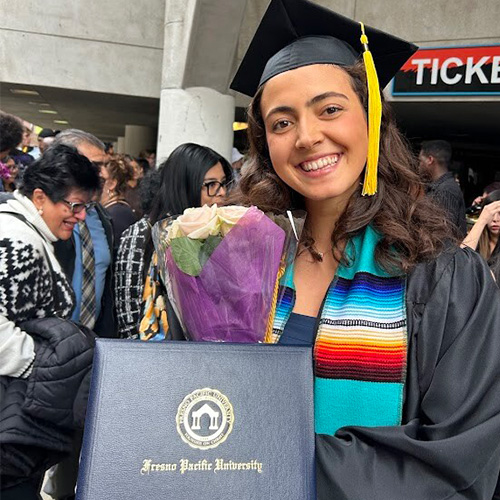
During her last semester as a psychology major at FPU, Esquer enrolled in Professor Lloyd Chia’s Juvenile Delinquency and the Justice System course as an elective, and her eyes were opened to a whole new possibility.
“And just like that, the seed Professor Lloyd planted during that semester basically changed my whole career,” Esquer says. “I was really wanting to go into the psychology field, but after taking his class, which was part of the criminology major, I knew I needed to reconsider my next steps. Restorative justice opened a new door and this whole new world that I’m learning about.”
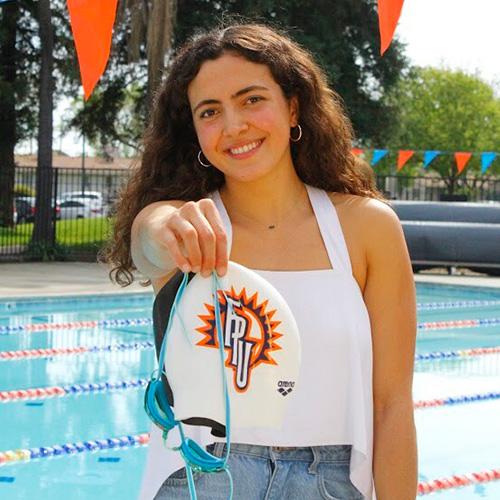
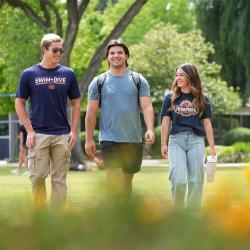
Esquer, who was a scholarship swimmer, student government representative and honor roll student at FPU, is on track to complete her master’s in restorative justice facilitation and leadership at the USD Center for Restorative Justice in San Diego, in January 2026. “The values and philosophies of restorative justice are what I was truly looking for,” she says. She recalls nearly taking a business class instead of Professor Chia’s, and is so grateful that there was something about his class that spoke to her and set her on her current path.
Esquer explains restorative justice as the repair of a harm done within a community by restoring balance through practicing accountability and respect for one another.
“There must be a response to the harm—a consequence—and that’s not always best for the victim or the offender,” she says. “But through the restorative lens, you see harm as an opportunity for the offender to be accountable and for the victim to heal through the process.” While restorative justice is not without controversy, Esquer says walking people through the process helps her find hope in discovering the good in all people.
Esquer describes herself as someone who’s always questioned the world and felt everything a little too deeply, and studying psychology seemed a logical choice to get the answers to why people are the way they are. She credits FPU with teaching her to try new things and providing opportunities to gain real-world experience outside the classroom. “If you really try and want to find something, there’s a lot offered by the school and community you can take advantage of,” she says. “My professors were always like, ‘Yes, go for it.’”
“While taking my juvenile delinquency class, she took the initiative to mentor a student from a local school even though it wasn't a class requirement,” Chia wrote. “She wanted to apply restorative justice and not just learn about it. I think that speaks volumes about the person Camila is.”
The road that led Esquer to FPU and then San Diego wasn’t straight or easy. Born in Texas, she grew up in Mexico City, where her family still resides. She started swimming professionally at age 7, which led to competing internationally. A meet in the U.S. sparked a dream to earn a college scholarship that would allow her to study here. She focused on her English-speaking skills to prepare her for that possibility, and was awarded a scholarship to swim at Oklahoma Baptist University. But the swim program was disbanded her freshman year, prompting her to transfer to FPU on academic and athletic scholarships.
Leaving her family to make her way in a new country while speaking a language that isn’t her first hasn’t been without its challenges, but Esquer sees each challenge as an opportunity to learn. “I never questioned why this was what I had to do. It helped me to be open to different cultures, different opportunities, and be open to the world and all it has to offer me,” she says. “It’s a challenge missing home, but I’ve been able to start a new family by meeting people from different cultures, and that’s amazing.”
For now, she’s taken on a facilitator role at a youth transition center in San Diego while she completes her graduate degree. She enjoys working with youth and seeing firsthand the powerful impact restorative justice can have on the rehabilitation process.
As she reflects on how FPU led her to where she is now, Esquer is thankful for the community of professors and friends she met there who helped her navigate the big questions that come with entering adulthood. “I had great mentors, and my professors were definitely a big part of my experience,” she says. “There’s something about the people who end up there who are truly special.”
Email storyteam@fresno.edu.